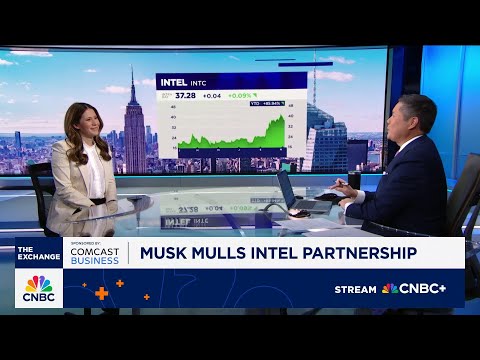
Intel's foundry strategy has shifted from a single Apple deal to a growing roster of major chip buyers in weeks. In early April 2026, Intel signed on as primary foundry partner for Terafab, a $25 billion AI chip venture backed by Tesla, SpaceX, and xAI.
Intel also formalized a multi-year AI infrastructure deal with Google to manufacture Xeon processors and co-develop custom data-center chips for Google Cloud. The company secured contracts to build Microsoft's Maia 2 AI processor and custom AI fabric chips for Amazon Web Services. All three deals rely on Intel's 18A manufacturing process, which reached high-volume production at its Arizona fab in late January 2026 with yields above 60%.
These customer wins have driven Intel's stock up roughly 76% in 2026, from around $39 at year's start to $68.50 by mid-April, adding more than $70 billion in market capitalization. The foundry order backlog has grown to more than $15 billion. Chief executive Lip-Bu Tan, who took over in March 2025, is now widely credited with delivering on the 'execution year' he promised at the start of 2026.
The first real financial test arrives April 23, when Intel reports first-quarter results. Management has guided for revenue of $11.7 billion to $12.7 billion, roughly flat year-over-year, with earnings near breakeven as the company continues investing in foundry capacity.
Why it matters
Whether Intel can manufacture chips for rivals like Apple determines if the West has a fallback if Taiwan's fabs go offline.
Questions about this story
Free account needed to ask — your question is kept and asked for you right after sign-up. Answers are public.
No questions yet — be the first to ask.
Key Indicators
$14.2B
Buyback price for Apollo's 49% Fab 34 stake
Apollo paid $11 billion for the same stake in June 2024, giving it a roughly $3 billion return in under two years.
$7.86B
Federal CHIPS Act direct funding awarded to Intel
The largest single award under the CHIPS and Science Act, supporting fabs in Arizona, Ohio, New Mexico, and Oregon.
24,000
Jobs cut under Lip-Bu Tan's restructuring
Approximately 15% of Intel's workforce, reducing headcount from 96,400 to roughly 75,000 by end of 2025.
~$295B
Intel market capitalization as of mid-April 2026
Stock trading around $68.50, up roughly 76% year-to-date as foundry customer wins accumulate.
$15B+
Intel Foundry order backlog
Customer pipeline includes Apple, Google, AWS, Microsoft, and Terafab; CFO cited 'billions per year' in packaging deals alone nearing close.
17 events
Latest: April 9th, 2026 · 5 months ago
Showing 8 of 17
JK to step
Tap a bar to jump to that date
Jump to
April 2026
Intel and Google announce multi-year AI infrastructure partnership
LatestDeal
Google agreed to deploy multiple future generations of Intel Xeon processors and co-develop custom infrastructure processing units for Google Cloud AI workloads, with newer Xeon 6 chips manufactured on Intel's 18A process. Intel shares rose ~4.7% on the announcement.
Intel Foundry lands AWS custom AI chip contract on 18A
Deal
Intel formalized a foundry agreement with Amazon Web Services to produce custom AI fabric chips on its 18A process node, adding a second hyperscaler to its foundry customer list alongside Apple.
Intel joins Elon Musk's Terafab as primary foundry partner
Deal
Intel was named primary foundry partner for Terafab, a $25 billion AI semiconductor joint venture between Tesla, SpaceX, and xAI targeting one terawatt of AI compute annually. Intel will contribute its 18A process and advanced packaging expertise; a fab is planned at Giga Texas in Austin. Shares jumped ~4% on the day and rose another ~11% the following session.
Intel pays $14.2B to buy back Apollo's Fab 34 stake
Financial
Intel announced a definitive agreement to repurchase Apollo's 49% equity interest in the Fab 34 joint venture for $14.2 billion, funded with cash and $6.5 billion in new debt. Shares surged 10%.
March 2026
Intel announces CPU price increases of up to 15%
Financial
Intel told customers it would raise processor prices by up to 15% to offset manufacturing costs and prioritize high-margin AI data center production. Shares climbed 4%.
January 2026
Intel 18A process reaches high-volume manufacturing
Manufacturing
Intel's 18A process node achieved high-volume manufacturing (HVM) status at Fab 52 in Arizona, producing approximately 40,000 wafers per month with yields reported above 60% — a key milestone qualifying the node for external foundry customers.
December 2025
Intel nears landmark Apple foundry deal
Deal
Reports emerged that Apple planned to use Intel's 18A-P process to manufacture entry-level M-series processors starting in 2027, allocating 15 to 20 million chips annually — a major validation of Intel's foundry ambitions.
March 2025
Lip-Bu Tan becomes Intel CEO
Leadership
Former Cadence Design Systems chief executive Lip-Bu Tan took over as Intel's chief executive, bringing semiconductor industry expertise and a reputation for operational discipline.
December 2024
Pat Gelsinger forced out as CEO
Leadership
Intel's board pushed out Pat Gelsinger after losing confidence in the pace of the turnaround. David Zinsner and Michelle Johnston Holthaus were named interim co-chief executives.
November 2024
CHIPS Act funding finalized at $7.86B
Government
Intel and the U.S. Department of Commerce reached final terms on a $7.86 billion direct funding award under the CHIPS and Science Act, reduced from the preliminary $8.5 billion figure.
August 2024
Intel announces massive layoffs after dismal earnings
Financial
Intel reported a terrible second quarter, announced 15,000-plus job cuts, suspended its dividend for the first time since 1992, and set a $10 billion cost-cutting target. The stock fell 26% in one day.
June 2024
Apollo invests $11B for 49% of Fab 34
Financial
Apollo Global Management led an $11 billion investment for a 49% equity interest in a joint venture tied to Intel's Fab 34 in Ireland, the second deal under Intel's co-investment program.
March 2024
Intel awarded $8.5B in preliminary CHIPS Act funding
Government
The Biden administration announced a preliminary agreement for the largest single CHIPS Act award, supporting Intel's fab projects in Arizona, Ohio, New Mexico, and Oregon.
September 2023
Fab 34 begins high-volume production
Manufacturing
Intel's Fab 34 in Leixlip, Ireland began high-volume manufacturing using Intel 4 technology with extreme ultraviolet lithography — a first for mass production in Europe.
August 2023
Tower Semiconductor acquisition collapses
Deal
Intel abandoned its $5.4 billion acquisition of Tower Semiconductor after failing to secure Chinese regulatory approval, paying a $353 million termination fee.
August 2022
Intel and Brookfield strike $30B Arizona fab deal
Financial
Intel introduced its Semiconductor Co-Investment Program, with Brookfield funding 49% of a $30 billion expansion of Intel's Chandler, Arizona campus. Intel retained majority ownership and operational control.
March 2021
Gelsinger launches IDM 2.0 strategy
Strategy
New Intel chief executive Pat Gelsinger announced plans to open Intel's factories to outside customers and invest $20 billion in two new Arizona fabs, creating Intel Foundry Services.
Scenarios
1
Intel Foundry lands multiple marquee customers, stock doubles by 2028
Possible
Discussed by: Bullish semiconductor analysts at Motley Fool, TrendForce, and financial media covering the Apple 18A-P deal
The Apple deal proves Intel can manufacture competitive chips for the world's most demanding customer. This draws additional foundry clients — potentially Qualcomm, Amazon, or defense contractors — filling Intel's fabs and justifying the tens of billions invested. Intel 18A yields improve on schedule, and the company reaches its 2027 growth inflection point. The CHIPS Act subsidies and full Fab 34 ownership give Intel a cost structure that lets it undercut TSMC on price for certain nodes. Intel's stock, already at $42, approaches $80-90 as the foundry business turns profitable.
2
Intel Foundry stalls: Apple deal shrinks, external customers stay with TSMC
Possible
Discussed by: Skeptics at SemiAnalysis, industry analysts who note Intel has promised foundry breakthroughs before without delivering
Intel 18A yields fall short of Apple's requirements, and Apple reduces or delays its order. Other potential customers, already locked into TSMC's ecosystem, see no reason to take the risk of switching. Intel Foundry continues burning cash, and the $14.2 billion spent on the Apollo buyback plus $6.5 billion in new debt strains the balance sheet. Tan is forced to revisit the co-investment model or explore further asset sales. Intel remains a product company with an expensive hobby foundry.
3
Geopolitical crisis accelerates Intel's foundry business overnight
Unlikely
Discussed by: National security analysts at the Center for Strategic and International Studies (CSIS), and U.S. policymakers who championed the CHIPS Act
A military confrontation or economic disruption involving Taiwan forces Western companies to find alternatives to TSMC. Intel, with operational fabs in Ireland, Arizona, and Oregon, becomes the only viable non-TSMC source for advanced logic chips in the West. Government contracts and emergency orders flood in. The entire rationale for the CHIPS Act — reducing dependence on Taiwan — is validated, and Intel's foundry becomes a strategic national asset regardless of its commercial competitiveness.
4
Intel splits into two companies: products and foundry
Possible
Discussed by: Wall Street analysts and activist investors who have long argued Intel's integrated model destroys shareholder value
If the foundry business continues requiring massive capital investment while the product division generates most of the profits, pressure builds to formally separate the two. Tan's 'two Intels' operating structure — Intel Products and Intel Foundry — already functions as a quasi-separation. A full split would let each business optimize independently: the product company could use any foundry, and the foundry could pursue any customer without competitive conflicts. This path becomes more likely if the Apple deal succeeds but overall foundry margins remain thin.
5
Terafab and hyperscaler deals cement Intel as the second global foundry — customers stop waiting for TSMC alternatives
Possible
Discussed by: Bullish analysts at 24/7 Wall St. and TIKR following the April 2026 customer wave; semiconductor industry observers covering Intel's 18A ramp
With Apple, Google, AWS, Microsoft, and Terafab all committed to Intel's 18A process, the narrative shifts from 'will Intel get any customers' to 'can Intel's fabs physically keep up.' Intel's backlog exceeds $15 billion and the company's Arizona campus becomes a genuine alternative to TSMC for leading-edge logic. The Intel Products division also uses 18A, eliminating the yield-sharing conflict of interest that plagued the early foundry strategy. Intel's stock approaches $100 as investors price in a recurring high-margin foundry revenue stream by 2028.
Historical Context
3 moments from history that rhyme with this story — and how they unfolded.
1 of 3
1987
TSMC's founding reshapes the chip industry (1987)
Morris Chang founded Taiwan Semiconductor Manufacturing Company with backing from the Taiwan government, creating the world's first pure-play semiconductor foundry — a company that manufactured chips designed by others. At the time, every major chip company ran its own factories, and the idea of outsourcing fabrication seemed radical.
Then
TSMC grew slowly at first, serving small design firms that couldn't afford their own fabs.
Now
The foundry model enabled an explosion of fabless chip companies — Qualcomm, Nvidia, Broadcom, AMD — and TSMC became the world's most important manufacturer, producing over 90% of advanced logic chips globally.
Why this matters now
Intel is now trying to become what TSMC built from scratch — a trusted manufacturer for other companies' chip designs. But TSMC had 37 years to build that trust and that ecosystem. Intel is asking customers to bet on a company that was their competitor until very recently.
2 of 3
September 1997
Steve Jobs returns to Apple (1997)
Apple, near bankruptcy, brought back co-founder Steve Jobs after a 12-year exile. Jobs slashed product lines from dozens to four, killed beloved projects, struck a controversial $150 million investment deal with Microsoft, and refocused the company on a handful of products he believed could win.
Then
Apple stabilized financially within two years. The iMac, launched in 1998, signaled the turnaround was real.
Now
Apple became the world's most valuable company. The radical simplification Jobs imposed — fewer products, deeper focus — became a business school case study in corporate turnarounds.
Why this matters now
Lip-Bu Tan's playbook echoes Jobs: cancel overambitious projects (Germany and Poland fabs), cut headcount dramatically, flatten management, and focus resources on the few bets that matter (18A process, Apple deal). The question is whether Tan can execute the same kind of focus-driven revival in a capital-intensive manufacturing business.
3 of 3
March 2009
AMD spins off GlobalFoundries (2009)
Advanced Micro Devices (AMD), Intel's longtime rival, spun off its entire manufacturing arm into a new company called GlobalFoundries, funded by Abu Dhabi's Mubadala Investment Company. AMD had been losing money trying to keep up with Intel's manufacturing spending and concluded it could not afford to both design and manufacture chips at the cutting edge.
Then
AMD became a 'fabless' chip designer, outsourcing manufacturing to GlobalFoundries and later TSMC. GlobalFoundries received billions in investment from Mubadala.
Now
AMD's decision to go fabless — widely mocked at the time — proved prescient. Freed from manufacturing costs, AMD designed chips that eventually overtook Intel in performance. GlobalFoundries eventually abandoned leading-edge manufacturing in 2018 and went public in 2021.
Why this matters now
Intel is attempting the opposite bet: doubling down on manufacturing while also keeping its design business. The AMD precedent is exactly what skeptics point to when they argue Intel should stop trying to be both designer and manufacturer.