



Pull to refresh
Logo
ICE detainee deaths under Trump's second term pass 57 as screening questions mount

ICE detainee deaths under Trump's second term pass 57 as screening questions mount

Rule Changes

Lianyong Wei died within hours of entering custody in Saipan; the agency won't confirm he received a required medical screening

September 2nd, 2026: NPR reports Wei as 57th death

Overview

Updated Sep 4

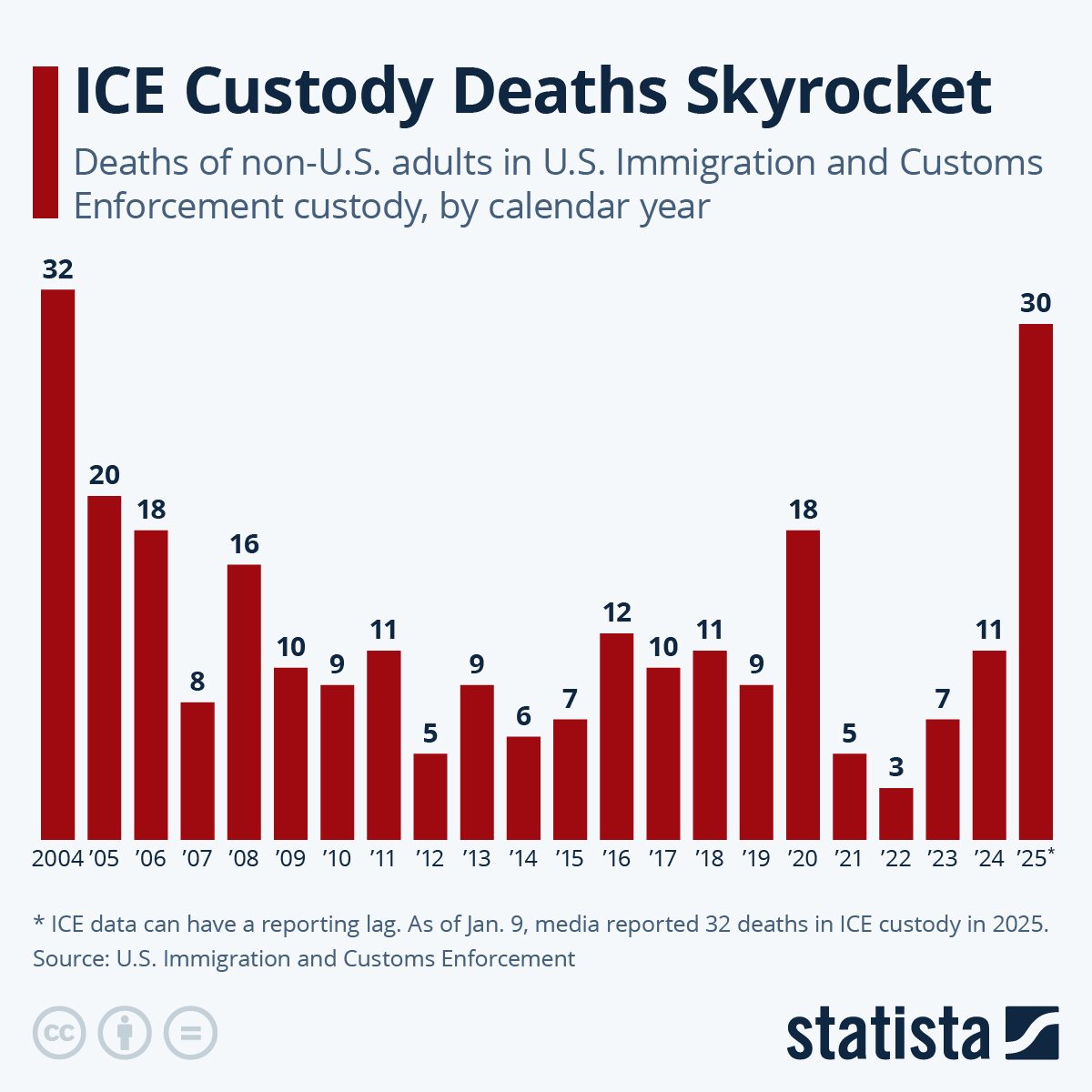
Lianyong Wei, a 51-year-old Chinese national, was booked into immigration detention in Saipan on Aug. 22. He was found unresponsive during morning checks the next day and pronounced dead at a territorial hospital at 7:30 a.m. His death marks the 57th detainee fatality since President Trump's second term began in January 2025, and the 24th since Jan. 1, 2026.

The open question: whether Wei received the basic health screening that Department of Homeland Security regulations require within 12 hours of intake. ICE has not said whether the screening happened, and DHS declined to answer. Medical experts say the intake check, deliberately broad and fast, is designed to catch conditions that can kill quickly in a locked setting — cardiac disease, insulin-dependent diabetes, seizure disorders, withdrawal risk, active infection, and acute suicide risk.

Why it matters

Federal rules promise every detainee a medical screening within 12 hours of intake; when a detainee dies within that window and the agency won't confirm the check happened, the system's safety guarantees become unverifiable.

Questions about this story

Free account needed to ask — your question is kept and asked for you right after sign-up. Answers are public.

No questions yet — be the first to ask.

Key Indicators

57
ICE detainee deaths since Jan. 20, 2025
Deaths recorded by ICE's detainee death notifications during Trump's second term.
24
Detainee deaths since Jan. 1, 2026
Deaths in the first eight months of 2026, per ICE's own notifications.
5
Chinese nationals who died in federal custody since March 2025
Wei is at least the fifth; two earlier deaths were ruled suicides, two were medical complications.
12 hours
Required window for initial medical screening
DHS regulations mandate a basic health screening within 12 hours of intake.

Voices

Curated perspectives — historical figures and your fellow readers.

Ever wondered what historical figures would say about today's headlines?

Sign up to generate historical perspectives on this story.

People Involved

Organizations Involved

Timeline

January 2025 September 2026

9 events Latest: September 2nd, 2026 · 1 week ago
Tap a bar to jump to that date
  1. NPR reports Wei as 57th death

    Latest Reporting

    Public reporting notes the death count and the unanswered question about his screening.

  2. Wei pronounced dead in Saipan

    Deaths

    Found unresponsive during morning checks; pronounced dead at territorial hospital.

  3. Wei transferred to ICE custody

    Detention

    Taken into ICE custody in Saipan pending removal proceedings.

  4. Wei arrested by CNMI police

    Arrest

    Arrested on charges of assaulting a family of five; accused of aggravated assault and battery.

  5. Chajon-Raxon detained at Delaney Hall

    Detention

    Guatemalan man suffers seizure-like episode after intake, is released July 22, later dies.

  6. Trejo requests medical help at Stewart center

    Medical

    Leukemia patient's request takes eight days to approve; he falls into a coma by July 15.

  7. Post-release death reporting rule eliminated

    Policy Change

    Trump administration ends Biden-era requirement to report deaths within 30 days of release.

  8. First Chinese national dies in federal custody

    Deaths

    At least five Chinese nationals die in ICE or Border Patrol custody through August 2026.

  9. Trump begins second term

    Administration Change

    ICE detainee death count begins accumulating under the new administration.

Scenarios

1

Investigation finds screen skipped; DHS tightens oversight

Possible Resolves by Mar 1, 2027

Discussed by: Medical experts and immigrant advocates quoted by Medical Daily and NPR

If the investigation into Wei's death finds that the 12-hour intake screening was not performed, the case pressures DHS to verify compliance across its roughly 200 contract facilities. Chinese diplomats have already pressed the U.S. for answers, adding diplomatic weight. Congress could hold hearings, and the June rollback of post-release death reporting could draw scrutiny.

2

Death rate holds; reporting rules stay loose

Possible Resolves by End of 2026

Discussed by: ICE's own guidance; DHS officials quoted by NPR

If the cause of death is ruled a natural medical event and the agency confirms a screening was completed, the case becomes a data point rather than a policy trigger. The June rule change removing post-release death reports remains in place, and the official count continues to exclude deaths like Trejo's and Chajon-Raxon's. The Mexican government's earlier alarm does not translate into bilateral pressure that changes U.S. detention practice.

3

Congress forces transparency after death count crosses 60

Unlikely Resolves by Jan 20, 2027

Discussed by: House and Senate immigration committees; Detention Watch Network

A continued climb in deaths — the tally is already at 57 with 24 in 2026 alone — could push lawmakers to reinstate a version of the Biden-era 30-day post-release reporting requirement. Advocacy groups like Detention Watch Network have documented gaps in the official count, including the Trejo case. A legislative fix could restore reporting requirements and add an independent audit of intake screenings.

Historical Context

2 moments from history that rhyme with this story — and how they unfolded.

July 2007

Eloy Detention Center deaths (2007)

Two detainees at the Eloy Detention Center in Arizona died within a month of each other. One was a Chinese national who died of heart failure; the other was a Mexican national with a history of seizures who stopped breathing in his cell. Reports later questioned whether basic medical checks were performed at intake.

Then

The facility's medical contractor faced criticism, and ICE reviewed its health screening standards.

Now

The deaths contributed to a series of reports finding that medical care in immigration detention was inconsistent across facilities — a finding that persists today.

Why this matters now

The Eloy deaths exposed the same failure mode: detainees arriving with conditions that a basic intake screening should catch, in facilities without around-the-clock clinical coverage. Saipan's small size makes it structurally similar to the under-resourced settings where these failures recur.

December 2018 – May 2019

Border Patrol custody deaths of migrant children (2018-2019)

Jakelin Caal, a 7-year-old from Guatemala, died in December 2018 after being held in Border Patrol custody in New Mexico. Five months later, 16-year-old Felipe Gomez Alonzo died in Texas custody. Both died of dehydration and organ failure after days without adequate food, water, or medical care.

Then

Border Patrol revised its medical screening protocols and faced scrutiny from the DHS Inspector General.

Now

The deaths became a recurring reference point in debates over detention conditions, but the underlying intake-screening system was never overhauled.

Why this matters now

The same 12-hour intake screening requirement exists today. Wei's death raises the same question the children's deaths raised: whether the check actually happens at small, understaffed facilities like Saipan's, which holds an average of 18 detainees on an island of 50,000 people.

Sources

(5)