
Pull to refresh
Logo
FDA approves first-of-its-kind hepatitis B drug from GSK and Ionis

FDA approves first-of-its-kind hepatitis B drug from GSK and Ionis

New Capabilities

Hibsago made the virus undetectable in 19% of trial patients; GSK says it reaches US pharmacies within about 10 days and is eyeing China next

Overview

Updated Oct 29

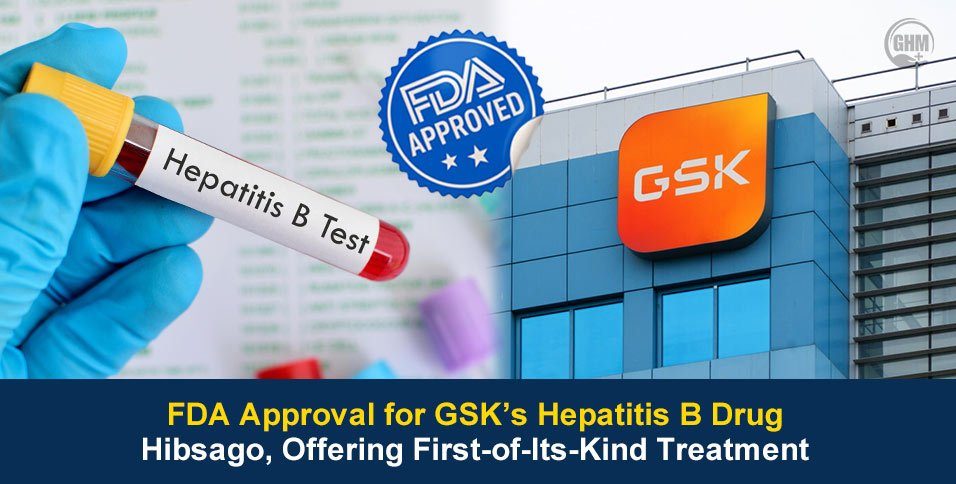
The Food and Drug Administration approved Hibsago on October 20 for adults with chronic hepatitis B who have no cirrhosis and have taken antiviral pills for at least six months. In two late-stage trials, 19% of patients who took it had no detectable virus 24 weeks after ending all treatment; none of the 614 placebo recipients did.

GSK told investors on October 28 that the drug should reach US pharmacies within about 10 days, with the launch aimed at patients whose surface antigen is below 1,000 IU/mL. The company named China as its next priority, saying the US, Japan and China hold about 80% of the drug's potential value. The label caps use at a surface antigen level of 3,000 IU/mL, measured with a Roche test cleared alongside the drug, and requires weekly platelet checks under a boxed warning for serious liver reactions.

Why it matters

If Hibsago delivers, millions of hepatitis B patients could stop daily antiviral pills for the first time, shifting the disease from lifelong management toward cure.

Questions about this story

Free account needed to ask — your question is kept and asked for you right after sign-up. Answers are public.

No questions yet — be the first to ask.

Key Indicators

19%
Functional cure rate in trials
Patients with undetectable virus 24 weeks after stopping all treatment. None of the 614 placebo patients reached that point.
24%
Patients able to stop existing medicine
Share of Hibsago recipients who met requirements to halt antivirals in the two Phase 3 trials, versus none on placebo.
26%
Cure rate when surface antigen is low
Among patients starting at or below 1,000 IU/mL, functional cure reached 25% in B-Well 1 and 28% in B-Well 2, versus 10% and 5% above that level.
91%
Responses held through week 96
Of 233 patients in a functional cure at week 72, 211 kept the virus suppressed 48 weeks after stopping therapy.
1.7M
US patients GSK expects to reach
The company's estimate of the US population that fits the label's eligibility criteria.
~$3B
Projected peak annual sales
Jefferies estimate; GSK says peak sales should exceed £2 billion.
0
Placebo patients cured
None of the 614 placebo recipients reached functional cure at week 72 while continuing standard antivirals.

Voices

Curated perspectives — historical figures and your fellow readers.

Sign up to generate historical perspectives on this story.

People Involved

Organizations Involved

Timeline

2019 October 2026

5 events Latest: October 28th, 2026 · 2 weeks ago
Tap a bar to jump to that date
  1. GSK sets US launch window and names China next

    Latest Commercial

    On its third-quarter earnings call, GSK said Hibsago should reach US pharmacies in about 10 days, with the launch focused on patients whose surface antigen is below 1,000 IU/mL. The company said the US, Japan and China account for about 80% of the drug's potential value, and that Japan has granted a positive reimbursement decision.

  2. FDA approves Hibsago with boxed warning

    Regulatory Approval

    US approval for chronic hepatitis B in certain adults without cirrhosis; first antisense drug for the disease. Roche companion diagnostic also cleared.

  3. GSK ends trial of follow-up hepatitis B drug

    Development

    GSK stopped a Phase 1 study of GSK3965193, a PAPD5/PAPD7 inhibitor, calling it a strategic decision. An siRNA candidate, GSK5637608, remains in Phase 2.

  4. Japan approves Hibsago

    Regulatory

    The drug wins its first regulatory clearance from Japan's regulator.

  5. GSK licenses bepirovirsen from Ionis

    Partnership

    GSK signs a collaborative development and licensing deal; Ionis is eligible for milestone payments and 10-12% royalties.

Scenarios

1

Hibsago becomes a hepatitis B blockbuster

Possible Resolves by End of 2028

Discussed by: Jefferies analyst Michael Leuchten

GSK reports quarterly sales that build toward the $3 billion peak forecast, driven by patients who fail or want to stop standard antivirals. The functional cure results published in the New England Journal of Medicine give prescribers evidence to support switching.

2

Safety monitoring and pricing stall Hibsago uptake

Possible Resolves by End of 2027

Discussed by: Jefferies analyst Michael Leuchten

The boxed warning for liver reactions and low platelets, plus weekly or bi-weekly lab tests, limits use to specialty centers. GSK's Nina Mojas said on October 28 that the monitoring requirements are likely to evolve over a patient's treatment course, with early checks mattering most. If the list price lands poorly against cheap lifelong generics, payers restrict coverage and sales lag the £2 billion peak expectation.

3

Hibsago wins European and Chinese approvals

Likely Resolves by End of 2027

Discussed by: GSK company statements; BioWorld

The drug is approved in Japan and the US and under regulatory review in China and Europe. GSK said on October 28 that China is its next priority and that the US, Japan and China make up about 80% of the drug's potential value. Clearances in those regions would expand the addressable market well beyond the US, where 1.7 million people live with chronic hepatitis B.

4

Rival hepatitis B cures crowd the market

Likely Resolves by End of 2028

Discussed by: H.C. Wainwright analysts, BioSpace

About 16 companies, including Gilead Sciences, Arrowhead Pharmaceuticals and Aligos Therapeutics, are developing hepatitis B treatments aimed at a functional cure. H.C. Wainwright wrote that Hibsago's approval establishes a starting point for a multi-product market.

5

Quantitative surface antigen testing becomes routine before hepatitis B treatment

Likely Resolves by Oct 31, 2027

Discussed by: Tatyana Kushner, hepatologist at Weill Cornell Medicine

The label ties eligibility to a surface antigen reading of 3,000 IU/mL or less, a measurement most US patients have never had. Kushner said quantitative HBsAg testing had not traditionally been performed for most patients but would likely play a role in finding those most likely to benefit.

Historical Context

2 moments from history that rhyme with this story — and how they unfolded.

December 2013 - 2014

Sovaldi and the hepatitis C cure (2013-2014)

Gilead's Sovaldi (sofosbuvir) cured more than 90% of hepatitis C patients in 8 to 12 weeks. The roughly $84,000 per-course price triggered a national debate over drug costs.

Then

Demand overwhelmed Gilead's supply, and insurers struggled with the cost of treating millions of patients.

Now

Hepatitis C became the first chronic viral infection to be broadly curable, and the WHO set global elimination targets.

Why this matters now

Both are antivirals marketed as cures for chronic liver infections. Hepatitis B is harder because the virus persists inside liver cells, so Hibsago aims for a functional cure: stopping symptoms and treating the infection without fully eradicating it.

January 2013

Mipomersen and the commercial limits of antisense drugs (2013)

The FDA approved Kynamro (mipomersen), an antisense oligonucleotide for an inherited high-cholesterol condition. It was the second antisense drug to reach the US market.

Then

Sales stayed tiny because the patient pool was small, the drug carried a boxed warning for liver toxicity, and it required injection.

Now

The drug largely failed commercially, showing that a modality's technical success does not guarantee market success.

Why this matters now

Hibsago is also an antisense oligonucleotide. Mipomersen's fate shows how safety warnings and narrow prescribing can limit an approved drug, the same risk analysts flag for Hibsago.

Sources

(15)