


Pull to refresh
Logo
Dead star's double debris ring offers a preview of the Solar System's end

Dead star's double debris ring offers a preview of the Solar System's end

New Capabilities

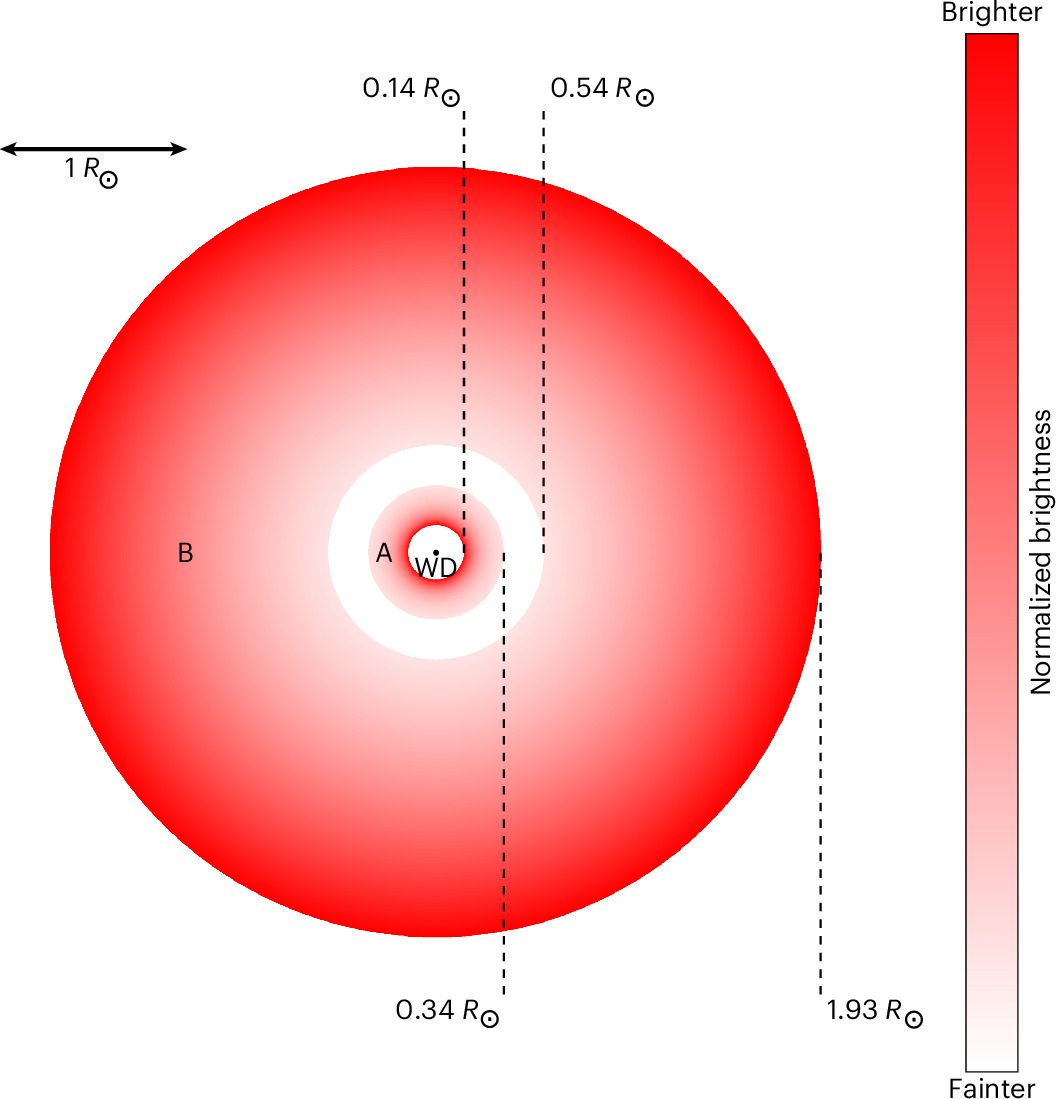
Two gas rings around white dwarf J1328−1450, likely shepherded by two surviving rocky bodies, break a pattern seen in every other known debris disc

Overview

Updated 6 days ago

The white dwarf J1328−1450 sits about 1,600 light years away, the burnt-out core of a star like the Sun. Two rings of glowing gas circle it, separated by an empty gap.

All 21 gas-rich discs found around white dwarfs before this one showed a single ring. The team that studied J1328−1450 says two rocky bodies survived the star's death and feed the rings, one possibly as big as Pluto. The inner ring carries far more magnesium than the outer one, which the authors read as a sign of two source bodies with different histories.

Why it matters

The Sun will become a white dwarf too. This system shows what may remain of the inner Solar System afterward.

Questions about this story

Free account needed to ask — your question is kept and asked for you right after sign-up. Answers are public.

No questions yet — be the first to ask.

Key Indicators

2
Concentric gas rings
Two spectroscopically distinct rings separated by a gap.
21
Gas-rich debris discs known before this one
Every one of them showed a single-ring signature.
4
Peaks in the calcium and oxygen lines
Single discs produce two peaks; this system produces four.
1.34 million km
Outer edge of the outer ring
About 3.5 times the Moon's distance from Earth.
2
Distinct chemical signatures
The inner ring is magnesium-rich; the outer ring is not, which the authors say points to two separate parent bodies.

Voices

Curated perspectives — historical figures and your fellow readers.

Sign up to generate historical perspectives on this story.

People Involved

Organizations Involved

Timeline

2021 November 2026

5 events Latest: 7 days ago
Tap a bar to jump to that date
  1. Nature publishes a research highlight

    Latest Publication

    Nature's news team summarises the finding for a wider readership.

  2. ESO announces the discovery

    Statement

    The observatory reports two candidate surviving bodies, one possibly Pluto-sized.

  3. Study published in Nature Astronomy

    Publication

    Gentile Fusillo and colleagues describe two gas rings around the white dwarf.

  4. Second observation confirms the pattern

    Observation

    Roughly two years later, the four-peak signal is unchanged.

  5. First spectrum of J1328−1450

    Observation

    The X-Shooter instrument on the Very Large Telescope records the white dwarf's light.

Scenarios

1

Follow-up observations pin down the two orbits

Possible Resolves by Q2 2028

Discussed by: The study authors, who say they cannot yet determine the exact orbits of the two candidate bodies

The team inferred two planetesimals from the gas behaviour but never saw them. Additional X-Shooter or higher-resolution spectroscopy could measure how the ring gas moves and fix each body's orbital path. That would turn a two-body inference into a measured architecture.

2

A second double-disc white dwarf turns up

Possible Resolves by End of 2029

Discussed by: Astronomers quoted in ESO and Nature coverage, who call the system the first of its kind

If two surviving rocky bodies can hold two rings apart, other white dwarfs should show the same four-peak signature. A survey reanalysis or a new X-Shooter campaign could find one. A second example would move the system from oddity to class.

3

A single warped disc replaces the two-body model

Unlikely Resolves by End of 2028

Discussed by: The study authors, who note that a bulging single disc could mimic the gap, though no existing model supports it

Four spectral peaks do not strictly require two rings. A disc that flares upward could shade the region where the gap appears. If a published model reproduces the signal with one disc and no second body, the surviving-planetesimal reading loses its footing.

Historical Context

2 moments from history that rhyme with this story — and how they unfolded.

Through October 2026

The single-ring baseline (through 2026)

Astronomers had identified 21 debris discs around white dwarfs that contain gas. Each one produced the same two-peak signature in its spectral lines, the fingerprint of a single flat, rotating ring. That uniformity made the two-peak pattern the standard test for these systems.

Then

Any new gas disc was expected to show two peaks, and most did.

Now

J1328−1450 broke the pattern with four peaks, forcing the field to consider that dead stars can host more complex disc structures.

Why this matters now

The 21-system baseline is what makes this discovery a first: without it, a double ring would be unremarkable.

Before 2026

SDSS J1228+1040 and the two-hour signal

Around another white dwarf, SDSS J1228+1040, astronomers detected a gas signal that repeated about every two hours. They could explain it only with a dense solid body inside the disc, shedding gas as it interacted with surrounding dust.

Then

The result established that a surviving rocky body can be inferred from gas behaviour alone.

Now

That method is the one Gentile Fusillo's team applied twice over at J1328−1450.

Why this matters now

It is the precedent for claiming two unseen planetesimals without ever imaging them.

Sources

(9)