


Pull to refresh
Logo
EV batteries retain about 90% capacity after 150,000 km, world's largest study finds

EV batteries retain about 90% capacity after 150,000 km, world's largest study finds

New Capabilities

500,000 tests show used electric cars far outlast early range-anxiety fears

4 days ago: Study reaches Reddit and wider public discussion

Overview

Updated 4 days ago

A study of more than 500,000 used electric cars finds most batteries keep about 90% of their original capacity after 150,000 km. The worst performer, the Nissan Leaf, still held 86.7%. None of the 20 models tested had lost more than 10% on average by 50,000 km.

The findings undercut a decade of fears that EV batteries would fail early. They also reveal wide gaps between individual cars of the same model, up to 13.5 percentage points at 150,000 km, which is why independent battery checks matter before buying used.

Why it matters

If battery anxiety fades, used EVs become a safer buy and resale values stabilize, removing a major barrier to mass EV adoption.

Questions about this story

Free account needed to ask — your question is kept and asked for you right after sign-up. Answers are public.

No questions yet — be the first to ask.

Key Indicators

~90%
Median battery state of health at 150,000 km
Most of the 20 models retained about 90% of original usable capacity at 150,000 km.
500,000+
Independent battery tests analyzed
Tests conducted 2022–2026 across North and South America, Europe, Australia, and Asia.
20
EV models compared
Median state of health measured at 50,000, 100,000, and 150,000 km for each model.
94%
Best median SoH at 150,000 km
Mercedes-Benz EQA led the field, with Hyundai Ioniq 5 at 93.8% and BMW i4 at 93.6%.
86.67%
Worst median SoH at 150,000 km
Nissan Leaf ZE1 degraded fastest, likely due to a smaller battery and passive cooling.
13.5%
Spread between best and worst same-model cars
At 150,000 km, individual Leaf examples varied by 13.5 percentage points in state of health.

Voices

Curated perspectives — historical figures and your fellow readers.

Ever wondered what historical figures would say about today's headlines?

Sign up to generate historical perspectives on this story.

People Involved

Organizations Involved

Timeline

January 2022 September 2026

4 events Latest: 4 days ago
Tap a bar to jump to that date
  1. Study reaches Reddit and wider public discussion

    Latest Public Attention

    The report becomes the top post on r/energy, amplifying evidence that batteries outlast fears.

  2. Aviloo publishes 500,000-test battery report

    Study Release

    Certified EV Battery Report shows most models retain about 90% capacity at 150,000 km.

  3. UK groups demand mandatory battery checks

    Regulatory Push

    Electrifying, New AutoMotive, and BatteryIQ call for state-of-health reports on every dealer-sold used EV.

  4. Aviloo begins collecting battery test data

    Data Collection

    Austrian diagnostics firm starts accumulating independent battery health measurements across global markets.

Scenarios

1

UK mandates battery health certificates for used EV sales

Possible Resolves by Q2 2027

Discussed by: Electrifying, New AutoMotive, BatteryIQ, and industry campaigners

The UK government adopts mandatory state-of-health checks for dealer-sold used EVs, standardizing the battery report Aviloo and others already offer. This would give buyers a verified number on every car and likely cool fears about hidden degradation.

2

Used EV prices stabilize as battery confidence spreads

Likely Resolves by End of 2027

Discussed by: Auto industry analysts and used-car platforms

With independent battery data widely available, buyers stop discounting used EVs for feared degradation. Resale values firm up and lease penetration grows as residual values look safer.

3

Battery guarantees become standard on used EV sales

Possible Resolves by Q2 2028

Discussed by: Dealers, leasing firms, and battery diagnostics providers

Aviloo's €3,000 battery guarantee model spreads. Major used-car platforms and dealer groups bundle state-of-health certificates with warranty protection, making degradation a manageable risk rather than a gamble.

Historical Context

2 moments from history that rhyme with this story — and how they unfolded.

2007–2015

Smartphone lithium-ion battery aging (2007–2015)

Early smartphone batteries swelled, died within a year, and sometimes caught fire. Users learned to expect their phone battery to degrade noticeably within 18 months of purchase.

Then

Replaceable batteries became a selling point, and manufacturers improved charging circuits and chemistry.

Now

Modern phone batteries last years longer, but the 'batteries wear out fast' mindset persisted across all lithium-ion products.

Why this matters now

The smartphone experience trained consumers to expect quick lithium-ion degradation. The new EV data shows automotive-grade battery engineering has moved well past that baseline.

2011–2017

First-generation Nissan Leaf battery degradation (2011–2017)

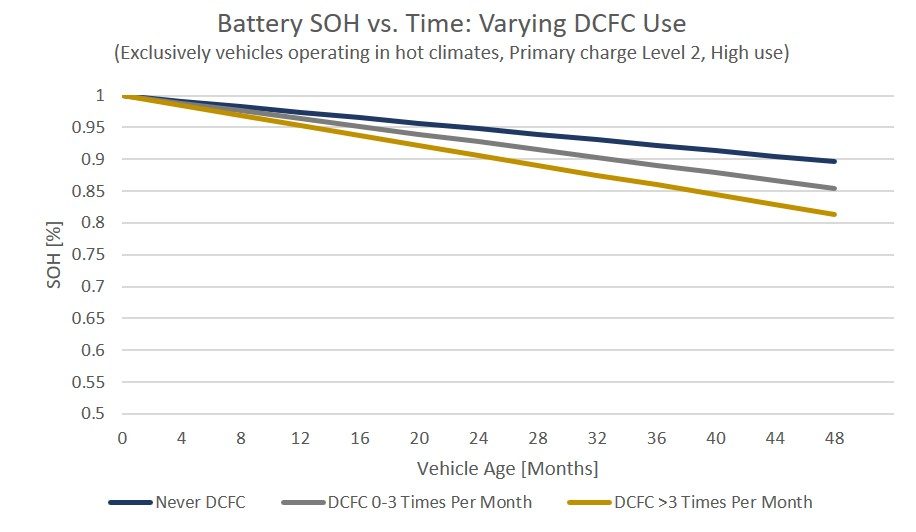
Early Nissan Leafs used air-cooled, small-capacity batteries with no active thermal management. In hot climates like Arizona, some packs lost 30% or more of their capacity within a few years, forcing Nissan to replace batteries under warranty complaints.

Then

The Leaf's reputation for degradation took root, feeding widespread consumer fear that all EV batteries would die quickly.

Now

Most automakers switched to liquid cooling and larger buffer zones, and later Leaf versions degraded far less.

Why this matters now

The 2026 Aviloo study shows modern EVs, including later Leafs, retain far more capacity than early models, directly addressing the fear those first cars created.

Sources

(9)