
Pull to refresh
Logo
Enbridge Line 5 pipeline shutdown fight

Enbridge Line 5 pipeline shutdown fight

Rule Changes

Michigan's seven-year battle to close a 73-year-old Great Lakes oil pipeline now turns on which courtroom decides its fate

April 22nd, 2026: Supreme Court rules Nessel case stays in federal court

Overview

Updated May 31

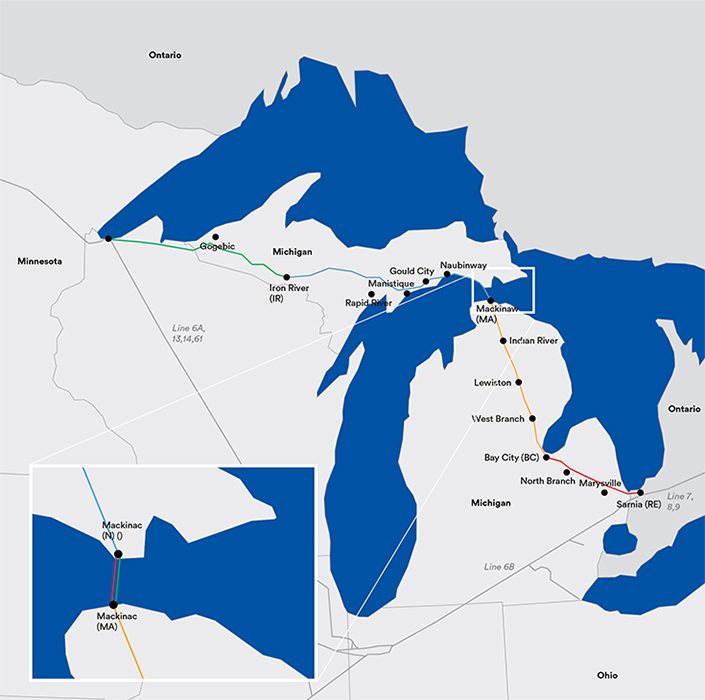
Two 20-inch oil pipelines have been pumping crude under the Straits of Mackinac since 1953, and Michigan has spent seven years trying to shut them down. On April 22, 2026, the Supreme Court ruled that the company defending the pipelines, Canadian operator Enbridge, gets to fight that battle in federal court, not the state courthouse Michigan picked.

The decision was narrow on its face: a unanimous procedural ruling that district judges can sometimes excuse the 30-day deadline for moving a state-court case to federal court. But it removes a major obstacle in Enbridge's path, as federal courts have so far been more receptive than Michigan judges to the argument that federal pipeline-safety law preempts state shutdown orders. The pipeline keeps flowing while the merits get sorted out.

Why it matters

Line 5 carries 540,000 barrels a day of crude and propane through the Great Lakes. Whether states or federal courts decide its fate will set the template for every interstate pipeline fight to come.

Questions about this story

Free account needed to ask — your question is kept and asked for you right after sign-up. Answers are public.

No questions yet — be the first to ask.

Key Indicators

73
Years pipeline has operated
Line 5 began carrying oil and natural gas liquids under the Straits of Mackinac in 1953.
540K
Barrels per day capacity
Daily volume of light crude, synthetic crude, and natural gas liquids moving through the line.
4.5 mi
Underwater crossing
Length of the dual pipeline span resting on the lakebed between Lake Michigan and Lake Huron.
887
Days Enbridge waited to remove case
Time between service of Michigan's complaint and Enbridge's transfer to federal court—well past the 30-day statutory deadline.
1.1M
Gallons spilled since 1967
Documented Line 5 leaks across its 645-mile length, per Enbridge filings reviewed by federal regulators.
$500M+
Estimated tunnel project cost
Price tag for the proposed concrete tunnel that would encase the Straits crossing—originally projected for 2024 completion.

Voices

Curated perspectives — historical figures and your fellow readers.

Andrew Carnegie

Andrew Carnegie

(1835-1919) · Gilded Age · industry

Fictional AI pastiche — not real quote.

"Seven decades of steel beneath those waters, serving the nation faithfully, and yet Michigan would sooner trust a state courthouse than the very federal law that built this industrial civilization — the Supreme Court, with characteristic wisdom, has reminded ambitious governors that pipelines, like great enterprises, answer to a higher jurisdiction than local sentiment."

Ever wondered what historical figures would say about today's headlines?

Sign up to generate historical perspectives on this story.

People Involved

Organizations Involved

Timeline

January 1953 April 2026

12 events Latest: April 22nd, 2026 · 5 months ago Showing 8 of 12
Tap a bar to jump to that date
  1. Whitmer revokes 1953 easement

    Executive Action

    Governor orders Line 5 shut by May 2021, citing what she calls incurable easement violations and unacceptable spill risk to the Great Lakes.

  2. Whitmer and Nessel take office

    Political

    Both Democrats took office having campaigned on shutting Line 5, immediately reopening questions about the tunnel deal and the underlying easement.

  3. Snyder administration approves Straits tunnel deal

    Agreement

    Outgoing Republican Governor Rick Snyder signs an agreement with Enbridge to build a concrete tunnel beneath the Straits to encase the pipeline, projected at $500 million with a 2024 completion date.

  4. Line 5 enters service under Michigan easement

    Construction

    Enbridge's predecessor company completes the 645-mile pipeline, including twin 20-inch pipes resting on the Straits of Mackinac lakebed. The state easement requires specific safety conditions on coating, supports, and curvature.

Scenarios

1

Federal court rules pipeline-safety law preempts Michigan shutdown

Likely

Discussed by: U.S. Chamber of Commerce, Washington Legal Foundation, energy-law analysts at Bloomberg Law

With the case now firmly in federal court, Enbridge presses the same argument that has worked in earlier rulings: the federal Pipeline Safety Act gives the Department of Transportation exclusive authority over interstate pipeline operation, leaving no room for state shutdown orders. A federal judge sided with Enbridge on this theory in late 2025 in a related ruling. If that reasoning holds for both Nessel's case and the Whitmer easement-revocation case, Michigan loses its primary legal lever and Line 5 keeps operating indefinitely under federal oversight.

2

Tunnel project completes, lakebed pipelines retired

Possible

Discussed by: Enbridge, Michigan Public Service Commission, building trades unions

Enbridge's proposed concrete tunnel beneath the Straits clears its remaining state and federal permits and breaks ground in 2027, with the new pipeline operational by 2030. The original twin pipes on the lakebed are decommissioned. This outcome ends the most acute spill-risk arguments while preserving the line itself, and may give Michigan political cover to drop active litigation. Bay Mills and other tribes have signaled they would still oppose the tunnel on treaty grounds.

3

Wisconsin reroute deadline forces shutdown of full line

Uncertain

Discussed by: Bad River Band, Earthjustice, Midwest Environmental Advocates

The June 2026 deadline from Judge Conley's 2023 ruling arrives before Enbridge has built the 41-mile reroute around the Bad River reservation. If the Army Corps permit is blocked or further delayed by tribal litigation, the Wisconsin segment shuts down—and because Line 5 is a single throughput, that shuts down the Michigan crossing too, regardless of how Michigan's own cases turn out.

4

Negotiated settlement with phased shutdown

Unlikely

Discussed by: Bridge Michigan, regional energy analysts, former state officials

After years of parallel litigation that neither side is decisively winning, Michigan and Enbridge reach a negotiated framework: continued operation for a defined period (typically 5-10 years) tied to specific tunnel construction milestones, with hard shutdown dates if benchmarks slip. Tribal nations would need to be at the table for any settlement to hold up against treaty challenges.

Historical Context

3 moments from history that rhyme with this story — and how they unfolded.

September 2008 - June 2021

Keystone XL pipeline cancellation (2008-2021)

TC Energy's proposed 1,179-mile pipeline to carry Alberta tar sands crude to Nebraska faced 12 years of permitting fights, federal lawsuits, and tribal opposition. President Obama denied the cross-border presidential permit in 2015; President Trump reissued it in 2017; President Biden revoked it on his first day in office in 2021. TC Energy abandoned the project five months later.

Then

The project died after $9 billion in committed investment, with TC Energy writing off the loss.

Now

Showed that even fully-permitted interstate pipelines can be killed by sustained political pressure if a key federal authority swings against the project. But Keystone XL was a new pipeline still seeking approval—Line 5 already exists and operates, which is a much harder thing to undo.

Why this matters now

Keystone XL is the cautionary tale for Enbridge: federal authority can flip a project off as easily as on. But it also shows why Enbridge fights so hard for federal jurisdiction—the alternative, scattered state and tribal vetoes, is harder to manage politically than a single federal decision.

July 2010

Kalamazoo River oil spill (2010)

Enbridge's Line 6B pipeline ruptured near Marshall, Michigan, releasing more than 1 million gallons of diluted bitumen crude into Talmadge Creek and the Kalamazoo River. Operators in the control room initially misread alarms and restarted the line twice during the spill. Cleanup took five years and cost over $1.2 billion.

Then

Largest inland oil spill in U.S. history at the time. The National Transportation Safety Board issued a scathing report criticizing Enbridge's culture as one of 'pervasive organizational failures.'

Now

Became the foundational evidence cited in every subsequent challenge to Enbridge pipelines, including Line 5. Drove federal pipeline safety reforms but also entrenched the company's status as the case study for catastrophic pipeline failure.

Why this matters now

Every Line 5 shutdown argument draws on Kalamazoo as proof that Enbridge's spill-response capability cannot match the speed of a Straits of Mackinac rupture. The 2010 event is why Michigan officials treat the underwater crossing as a question of when, not if.

April 2016 - February 2017

Dakota Access Pipeline and Standing Rock (2016-2017)

The Standing Rock Sioux Tribe and thousands of allied activists camped at the Cannonball River in North Dakota to block construction of the 1,172-mile Dakota Access Pipeline beneath Lake Oahe, the tribe's water source. The Obama administration paused the federal easement in December 2016; the Trump administration reversed course weeks later and the pipeline began operating in June 2017.

Then

Pipeline went into service over tribal objections after federal authority shifted between administrations. Standing Rock's legal challenges continued in federal court for years afterward.

Now

Established the modern template for tribal-rights pipeline opposition and showed how federal preemption can override both state and tribal objections. Also demonstrated how project economics can survive years of delay if a federal forum is willing to keep the line open.

Why this matters now

Like Line 5, Dakota Access turned on whether federal jurisdiction would override local and tribal sovereignty claims. Both fights show that for interstate pipelines, the choice of courtroom often determines the outcome before the merits are even argued.

Sources

(11)