


Pull to refresh
Logo
Amazon expands Prime Air drone delivery toward nearly 500 US cities

Amazon expands Prime Air drone delivery toward nearly 500 US cities

Built World

A 13-year-old promise scales from 11 metro areas to a near-nationwide network by year-end

August 19th, 2026: Amazon targets nearly 500 cities by year-end

Overview

Updated Aug 19

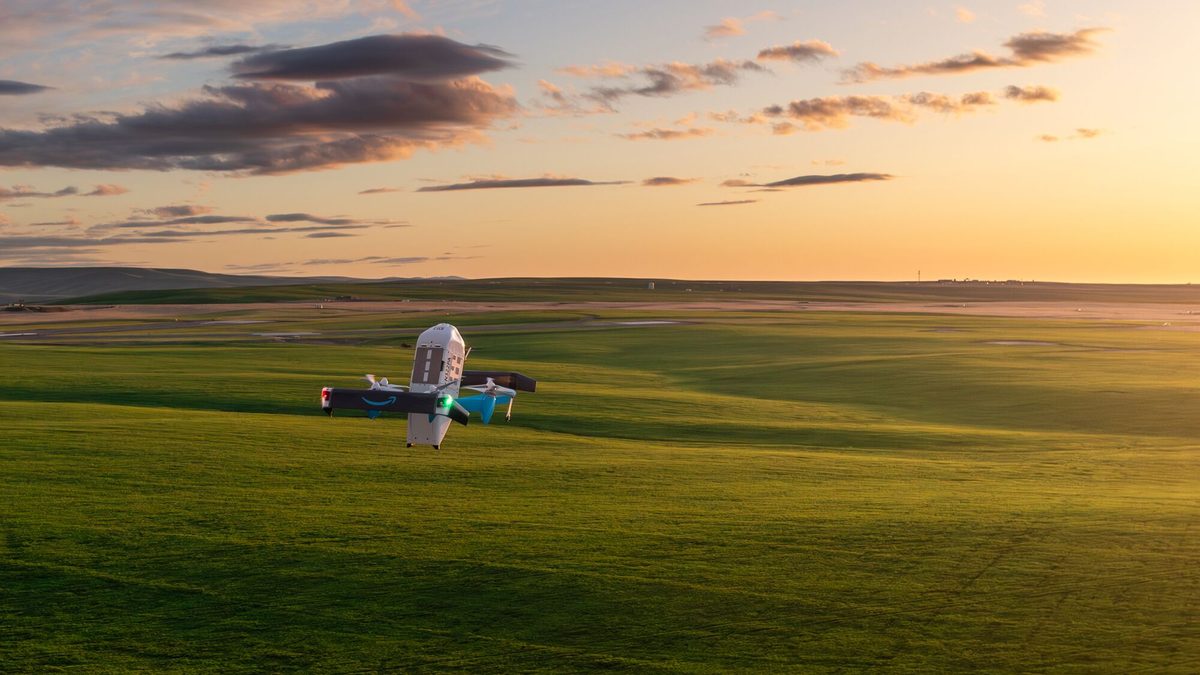
Order a bottle of vitamins or a phone charger in one of a few US towns, and a drone drops it in your yard within 30 minutes. Amazon now wants that in nearly 500 cities and towns by the end of 2026, up from 11 metro areas today.

The plan is a roughly sixfold jump in one year. Amazon says it has already made hundreds of thousands of drone deliveries in 2026, with thousands a day, and its Prime Air chief has told staff the goal is 1 million deliveries this year.

Why it matters

If Amazon hits its target, tens of millions of Americans could get small everyday items dropped at home in half an hour, reshaping last-mile delivery.

Questions about this story

Free account needed to ask — your question is kept and asked for you right after sign-up. Answers are public.

No questions yet — be the first to ask.

Key Indicators

~500
Cities and towns targeted by end of 2026
Up from 11 metro areas across seven states now.
6x
Size of the planned network expansion
The rollout would multiply Prime Air's footprint about sixfold in one year.
1M
Deliveries Amazon aims to make in 2026
Prime Air VP David Carbon's internal target, per a recording obtained by CNBC.
5 lbs
Maximum package weight per drone
Amazon says this covers more than 60% of its most-ordered items.
13 yrs
Years since Bezos first showed the drones
Jeff Bezos unveiled Prime Air on 60 Minutes in December 2013.

Voices

Curated perspectives — historical figures and your fellow readers.

Ever wondered what historical figures would say about today's headlines?

Sign up to generate historical perspectives on this story.

People Involved

Organizations Involved

Timeline

December 2013 August 2026

5 events Latest: August 19th, 2026 · 3 weeks ago
Tap a bar to jump to that date
  1. Amazon targets nearly 500 cities by year-end

    Latest Announcement

    Amazon says Prime Air will expand from 11 metro areas to nearly 500 US cities and towns by the end of 2026. Chicago, Atlanta, Cleveland, Syracuse and Boise are named as next launch areas.

  2. FAA clears beyond-line-of-sight flights

    Regulatory

    The FAA lets Amazon fly drones beyond the operator's visual range, a change that lets each site cover far more area.

  3. First customer deliveries begin

    Operations

    Prime Air makes its first drone deliveries to customers in Lockeford, California and College Station, Texas.

  4. FAA approves Amazon's drone fleet

    Regulatory

    Amazon wins Federal Aviation Administration approval to operate a commercial drone delivery fleet, seven years after the reveal.

  5. Bezos unveils Prime Air on 60 Minutes

    Announcement

    Jeff Bezos shows a prototype octocopter and promises 30-minute delivery of packages under five pounds. He estimates four or five years to launch.

Scenarios

1

Amazon reaches near-nationwide drone coverage on schedule

Possible Resolves by End of 2026

Discussed by: Amazon (aboutamazon.com), CNBC, GeekWire

Amazon clears the FAA approvals and site buildouts fast enough to bring Prime Air to at least 400 US cities and towns by the end of 2026. Launches in Chicago, Atlanta, Cleveland, Syracuse and Boise proceed, and the network approaches the roughly 500-community goal.

2

Prime Air passes 1 million deliveries in 2026

Uncertain Resolves by Feb 28, 2027

Discussed by: CNBC (citing VP David Carbon's internal remarks)

Daily volume keeps rising as new sites open, and Amazon hits the 1 million annual delivery mark that Carbon set internally. Confirmation would come through an Amazon statement or a reported delivery tally for the year.

3

Rollout stalls well short of the 500-city goal

Possible Resolves by End of 2026

Discussed by: GeekWire, drone-industry analysts noting Amazon's history of delays

Regulatory bottlenecks, noise complaints, or site logistics slow the buildout, and Prime Air ends 2026 in far fewer than 400 communities. The pattern would echo Amazon's repeated missed timelines since 2013.

4

Safety incident forces a pause in drone operations

Unlikely Resolves by End of 2026

Discussed by: FAA safety oversight, aviation press

A crash, injury, or airspace incident prompts the FAA or Amazon to suspend Prime Air flights in one or more markets during the expansion. A grounding would test whether the scale-up outran its safety record.

Historical Context

3 moments from history that rhyme with this story — and how they unfolded.

April 1973

FedEx launches overnight air delivery (1973)

Fred Smith started Federal Express with 14 small jets flying packages through a single Memphis hub overnight. The first night moved 186 packages. Critics doubted anyone would pay a premium for next-day delivery.

Then

The company burned through cash and nearly folded in its first two years.

Now

Overnight delivery became a standard business tool, and the hub-and-spoke model reshaped global logistics.

Why this matters now

Like Prime Air, it tried to build a new delivery category that skeptics doubted. It shows such bets can take years to pay off, or fail early.

December 2001

Segway unveiled as urban transport (2001)

Inventor Dean Kamen revealed the Segway with claims it would reshape how cities are built. Backers predicted sales of tens of thousands of units a month.

Then

Sales came in a tiny fraction of forecasts in the first years.

Now

The device found narrow uses in tours and warehouses, never the mass adoption promised, and production ended in 2020.

Why this matters now

A cautionary case where a heavily hyped technology underdelivered. It frames the open question of whether drone delivery becomes routine or stays a niche.

October 2016

Zipline drone medical delivery in Rwanda (2016)

Startup Zipline began flying blood and medical supplies by drone to clinics across Rwanda, launching from fixed distribution centers to remote sites doctors struggled to reach by road.

Then

The service cut delivery times for urgent blood supplies from hours to minutes.

Now

Zipline scaled to millions of commercial deliveries and over 100 million autonomous miles, expanding into US retail and pharmacy delivery.

Why this matters now

It proved drone delivery works at scale in a defined use, and Zipline now competes with Amazon in the US, showing the market Amazon is racing to lead.

Sources

(4)