


Pull to refresh
Logo
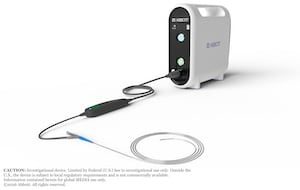
Abbott's SonicForce meets both endpoints in pivotal coronary calcium trial

Abbott's SonicForce meets both endpoints in pivotal coronary calcium trial

New Capabilities

The investigational lithotripsy balloon posted 0.3% target lesion failure and 97% procedural success, and Abbott now expects FDA approval in the first half of 2027

Overview

Updated 4 days ago

Abbott's SonicForce met both of its primary endpoints in a 335-patient U.S. study of severely calcified coronary arteries. Thirty-day target lesion failure was 0.3% and procedural success was 97.0%, results presented Nov. 1 at the TCT conference in San Diego and published in JACC: Cardiovascular Interventions.

Abbott now says it expects FDA approval in the first half of 2027. Analysts at Evercore ISI cautioned that the trial treated shorter calcified lesions than studies of competing devices, which they said affected the endpoints.

Why it matters

A second coronary lithotripsy supplier would give U.S. hospitals leverage against Johnson & Johnson's Shockwave, which has had the market largely to itself.

Questions about this story

Free account needed to ask — your question is kept and asked for you right after sign-up. Answers are public.

No questions yet — be the first to ask.

Key Indicators

0.3%
30-day target lesion failure
One event among 330 evaluable patients; the performance goal was 12.9%.
97.0%
Procedural success
324 of 334 evaluable patients; the performance goal was 87.1%.
335
Patients enrolled
Single-arm study across 40 U.S. centers.
66.3%
Calcium fracture after stenting
53 of 80 lesions in the optical coherence tomography substudy.
95.9%
Stent expansion at maximum calcium
Measured at the site with the largest contiguous calcium arc.
H1 2027
Expected FDA approval
Abbott's stated timeline for a U.S. decision on SonicForce, given at TCT 2026.

Voices

Curated perspectives — historical figures and your fellow readers.

Sign up to generate historical perspectives on this story.

Organizations Involved

Timeline

4 events Latest: November 1st, 2026 · 1 week ago
Tap a bar to jump to that date
  1. TECTONIC CAD meets both primary endpoints

    Latest Clinical results

    Abbott reported 0.3% 30-day target lesion failure and 97.0% procedural success in 335 patients across 40 U.S. centers.

  2. Imaging substudy shows calcium fracture in two-thirds of lesions

    Clinical results

    Optical coherence tomography found calcium fracture in 66.3% of 80 assessed lesions after stenting, with 95.9% stent expansion.

  3. Abbott says it expects FDA approval in the first half of 2027

    Regulatory outlook

    At TCT 2026, Abbott said it expects the FDA to approve SonicForce in the first half of 2027.

  4. Analysts flag shorter lesions in TECTONIC than in rival trials

    Analysis

    Evercore ISI analysts said the trial's calcified lesion lengths were smaller than in studies of competing devices and had an impact on the endpoints.

Scenarios

1

FDA approves SonicForce for severely calcified coronary lesions

Likely Resolves by End of 2027

Discussed by: Abbott and the TECTONIC CAD investigators, who designed the single-arm study against prespecified performance goals to support market approval

Abbott submits a premarket approval application built on the 335-patient TECTONIC data, and the FDA clears the device for use before stenting in severely calcified de novo lesions. Approval would make SonicForce the second coronary lithotripsy system sold in the United States and the first direct competitor to Shockwave.

2

FDA convenes an advisory panel before deciding on SonicForce

Possible Resolves by Q2 2027

Discussed by: Device industry analysts watching the coronary lithotripsy category

The FDA refers the application to its Circulatory System Devices Panel, adding a public meeting and several months to the review. A panel would focus attention on the single-arm design, which has no randomized comparison group, and on the small number of clinical events in the trial.

3

Two-year TECTONIC data show target lesion failure above 5%

Unlikely Resolves by End of 2028

Discussed by: The TECTONIC CAD authors, who note that follow-up through two years is ongoing and needed to test durability

The 30-day event rate was built on a single event. If late failures, restenosis or stent thrombosis accumulate as follow-up extends, the device's early advantage narrows and the case for broad use weakens. The trial protocol excludes heart attack patients, cardiogenic shock and dialysis patients, so longer data would also test how the results hold outside the studied population.

Historical Context

3 moments from history that rhyme with this story — and how they unfolded.

2021

Disrupt CAD III (2021)

Shockwave Medical ran the first pivotal U.S. trial of a coronary lithotripsy balloon, treating severely calcified lesions before stenting. The study reported 92.2% freedom from major adverse cardiac events at 30 days and 92.4% procedural success.

Then

The results supported U.S. market approval for Shockwave's coronary system, making lithotripsy an alternative to atherectomy and specialty balloons.

Now

Shockwave became the dominant coronary lithotripsy supplier, and Johnson & Johnson acquired the company in 2024.

Why this matters now

Disrupt CAD III is the benchmark every coronary lithotripsy trial is now measured against, and TECTONIC's lower event rate is the comparison Abbott will make to regulators and hospitals.

Early 1980s

Extracorporeal shock wave lithotripsy (early 1980s)

Clinicians in Germany began using focused acoustic shock waves to shatter kidney stones without surgery, an approach that became a standard urology treatment.

Then

Patients avoided open surgery for a common and painful condition.

Now

The physics of focused pressure waves became a platform technology, later adapted to break calcium inside blood vessels.

Why this matters now

Coronary lithotripsy is a direct descendant of that work, which is why Abbott's press materials compare the device to kidney stone treatment.

1990s

Rotational atherectomy (1990s)

Diamond-tipped burrs that drill through calcified plaque entered cardiology practice as the first dedicated tool for lesions balloons could not open.

Then

Operators gained a way to modify calcium, but the procedure required specialized technique and carried risks of burr entrapment and slow flow.

Now

Atherectomy remained a niche tool used by experienced operators, leaving room for balloon-based alternatives.

Why this matters now

Atherectomy is the incumbent approach lithotripsy competes with, and Abbott already sells an orbital atherectomy system alongside the SonicForce program.

Sources

(11)