
Pull to refresh
Logo
Lost Schrödinger manuscript reveals his hidden-variable quantum model

Lost Schrödinger manuscript reveals his hidden-variable quantum model

New Capabilities

The 82-year-old draft, filed as W33-781/9 in Vienna, shows Schrödinger defended determinism's possibility without believing in it

Overview

Updated Oct 24

Erwin Schrödinger wrote a three-page reply in late November 1944 arguing that physics could not rule out a deterministic universe. He never published it, and the draft, filed as W33-781/9, sat in Vienna's Schrödinger archive until this year.

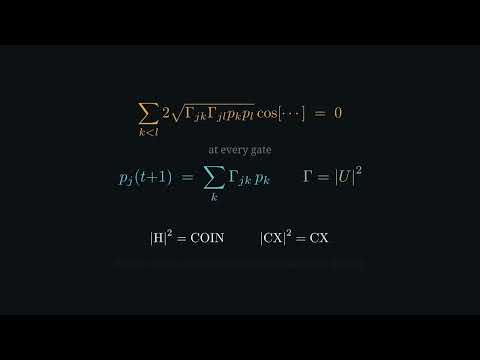
Flavio Del Santo, a physicist at the University of Geneva and Constructor University Bremen, transcribed it and posted his analysis on arXiv. The model gives each photon a hidden value between 0 and 1, plus a threshold rule that reproduces quantum mechanics' predictions for polarized light. Del Santo reads the draft as a proof of principle, not a declaration that Schrödinger believed in a predetermined universe.

Why it matters

Quantum randomness may be a limit on what we can know rather than on nature itself, a question Schrödinger's draft leaves open.

Questions about this story

Free account needed to ask — your question is kept and asked for you right after sign-up. Answers are public.

No questions yet — be the first to ask.

Key Indicators

82
Years manuscript sat unpublished
Drafted in late 1944, the three-page response stayed in Vienna's Schrödinger archive until 2026.
3
Manuscript pages
Schrödinger's handwritten response ran three pages.
0–1
Range of Schrödinger's hidden variable
His model gave each photon a hidden value anywhere between zero and one, not just two choices.
25%
Photons through a 60-degree filter in the model
With the polarizer at 60 degrees, only photons whose hidden value exceeds 0.75 pass, matching Malus's law.

Voices

Curated perspectives — historical figures and your fellow readers.

Sign up to generate historical perspectives on this story.

People Involved

Organizations Involved

Timeline

May 1943 October 2026

7 events Latest: October 22nd, 2026 · 3 weeks ago
Tap a bar to jump to that date
  1. Manuscript's contents revealed to the public

    Latest Publication

    ScienceAlert and other outlets publish detailed accounts of Del Santo's study, bringing the lost draft to wide attention.

  2. Del Santo posts analysis on arXiv

    Research

    Flavio Del Santo publishes the first transcription and analysis of Schrödinger's manuscript, reconstructing the debate's history.

  3. Schrödinger drafts hidden-variable response

    Manuscript

    Schrödinger writes a three-page response giving photons a continuous hidden variable and a rule for updating it after each filter. Del Santo dates the text to after 25 November 1944 because it cites a letter from Barkas. Schrödinger never publishes it.

  4. Nature reports Bose's address

    Publication

    Mathematician H.T.H. Piaggio writes up Bose's address for Nature under the title 'Collapse of Determinism,' reaching European physicists.

  5. Bose addresses Indian Science Congress on determinism

    Address

    Satyendra Nath Bose delivers his presidential address to the Indian Science Congress in Delhi, arguing determinism had collapsed.

  6. Pelzer publishes hidden-variable model

    Publication

    Heinrich Pelzer publishes a model showing Whittaker's argument that photons can't carry hidden instructions doesn't hold.

  7. Whittaker argues quantum mechanics ended determinism

    Lecture

    E.T. Whittaker gives the Guthrie Lecture in London, arguing quantum mechanics destroyed the classical idea of a predictable universe.

Scenarios

1

Del Santo's analysis clears peer review and publishes in a journal

Likely Resolves by End of 2027

Discussed by: The paper is currently an arXiv preprint; Del Santo's prior work has appeared in peer-reviewed venues in quantum foundations.

Del Santo submits his transcription and analysis of Schrödinger's manuscript to a peer-reviewed journal in the history of physics or quantum foundations. Acceptance would make the study the canonical reference for the episode and likely draw further scholarly attention to the manuscript.

2

Vienna archive digitizes the Schrödinger manuscript

Possible Resolves by Q2 2028

Discussed by: Del Santo's study relies on archival documents; digitization typically follows scholarly interest.

The University of Vienna's Schrödinger archive releases a digital scan of the three-page draft, making it accessible to researchers and the public. This would allow independent verification of Del Santo's transcription and broader study of the document.

3

Schrödinger's model enters the living determinism debate

Possible Resolves by End of 2027

Discussed by: The sanjaysays.com analysis notes that Bell's later work suggests Schrödinger had the better of the argument against impossibility proofs.

A paper in a major physics or foundations journal cites Schrödinger's 1944 model in the current debate over hidden variables and quantum randomness, beyond purely historical treatment. The sanjaysays analysis argues Schrödinger's 'caution stands' against later impossibility proofs, making such a citation plausible.

Historical Context

3 moments from history that rhyme with this story — and how they unfolded.

1952

Bohm's pilot wave theory (1952)

David Bohm published a fully deterministic hidden-variable theory, the pilot wave, that reproduces all quantum mechanics predictions. It was largely ignored for decades before gaining attention.

Then

Bohm's theory demonstrated mathematically that a deterministic reformulation of quantum mechanics was possible, contradicting the prevailing orthodoxy.

Now

It became the leading example of a viable hidden-variable theory, revived in modern foundations-of-physics debates.

Why this matters now

Bohm's work shows deterministic models of quantum mechanics were viable, echoing the proof-of-principle approach Schrödinger took in his lost manuscript.

1932–1935

Von Neumann's impossibility proof and Grete Hermann's critique (1932–1935)

John von Neumann's 1932 book claimed to prove that hidden variables were impossible. In 1935, philosopher Grete Hermann identified a flaw in the proof, though her critique went largely unnoticed until Bell's 1966 paper dismantled von Neumann's argument.

Then

Von Neumann's proof was widely accepted, and Hermann's critique was ignored for decades.

Now

Bell's 1966 analysis confirmed Hermann's objection, showing that a celebrated impossibility proof was wrong.

Why this matters now

The episode supports Schrödinger's 1944 refusal to call determinism impossible — a well-known 'impossibility proof' later collapsed under scrutiny.

1964

Bell's theorem (1964)

John Bell published a theorem showing that no local hidden-variable theory can reproduce all predictions of quantum mechanics. Subsequent experiments confirmed the inequalities he derived.

Then

Bell's work ruled out local hidden variables, a major constraint on deterministic reformulations.

Now

It showed that while determinism might not be impossible, local hidden variables cannot match quantum mechanics. Experiments continue to test the boundaries.

Why this matters now

Bell's work validated Schrödinger's caution that no proof can settle the determinism question, even as it closed off local hidden-variable models.

Sources

(10)